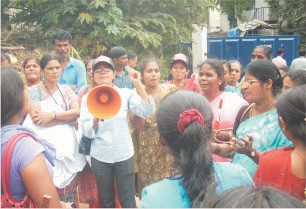
 Historically , world over, the women have often played a very militant and successful role in bringing about social reforms and political changes. But in India, the residual effect of landlord-ism and the grotesque capitalist practices, have pushed women to remain just as objects of sexual glorification and machines of reproduction to cater to the needs of the system itself.
Socialists and all those fighters who seek a fundamental change in society will have to place women and the perspectives of women in the forefront of their struggle, otherwise change will remain as a mirage for times to come. Geographically between continents, between countries and with different social systems, there may be differences and obstacles from traditions. But in-spite of all this, it is the struggle against the profiteering capitalism that will transcend all these obstacles for a united, common struggle.
Today, as we can see, in Asia, Africa and particularly in the West Asian countries where unprecedented struggles are taking place, women are playing a pioneering role. In the revolutions to come, women will be in the forefront of titanic struggles sharing the revolutionary responsibility with the working class and the other exploited sections of the society. In the recent period, millions of women both in the developed and the developing have fought against cuts and austerity measures, which brings down their living standards to abysmal levels.
Garment and Textile women workers of Bangladesh and in other Asian countries are waging valiant struggles which is spreading like wild fire across countries and continents. Women workers in public sector are fighting against cuts in subsidies and young women have risen in revolt against fee increases in education in countries like Britain and in other European countries. In recent times, women of Egypt and Tunisia participated in tens of thousands against the undemocratic dictatorial regimes there and successfully removed these despots from power. In the coming period, the West Asian thunder is likely to increase to a storm where far reaching political changes will be on the anvil.
In the last four decades, precisely because of the militant struggle of the women, social and economic conditions in advanced capitalist countries has seen a progressive change. Though it is true that inequality, gender injustice, domination and oppression is yet to see the end of the day, but the will to fight is universally conspicuous today.
In Asia, Africa, parts of Latin America and West Asian neo-colonial countries, the situation of women is completely the opposite. Though capitalist globalisation’s hunt for cheap labour and resources, has to an extent released women from drudgery and domestic slavery by providing them jobs in offices and factories, yet the crisis of world capitalism and and its disastrous effect has become a nightmare to the ordinary women of the developed and developing countries. The inherent cut throat competition of profit seeking capitalism, carries with it the inevitable exploitation and domination. The only alternative is to fundamentally overthrow capitalism from its roots and replace it with a democratic socialist alternative.
Women struggle for political rights: Sharmila Irom- Fighter Extraordinaire
On November 4, 2011, Manipuri poet Irom Sharmila Chanu’s hunger fast completed 11years. She has not touched water or food during this period, she is being force-fed through nose and has been charged for attempt to commit suicide. No man or woman in the history of any struggle anywhere in the world has ever gone through such a long, consistent period of hunger fast. Hence, Irom Sharmila Chanu has today become a unique symbol of struggle for justice.
Sharmila’s demand is simple and humane: Repeal the draconian law, the Armed Forces Special Powers Act (AFSPA). The brutalities under AFSPA is not limited to Manipur, is all over north east India as well as Kashmir. AFSPA equips the security forces with unrestricted powers including the power to arrest and enter any home or dwelling without warrant as well as the power to shoot, arrest and kill at the hint of a mere suspicion,
Women & Work
In the recent period, women have increasing opportunities to come out of the houses and work. In some countries, women outnumber men in some sectors, but in almost all these situations the wages that women draw is far less than the average wage of male worker. Even today, total economic independence is a far cry for women. In the beginning of the world capitalist crisis of the recent times, there were mixed effects on women’s jobs. In US, while men lost job in manufacturing and construction, women bore the brunt in the service sectors. In Britain, the recession has pushed thousands of women from jobs in the service economy, who have now joined the teeming unemployed army.
All the governments of these countries have continued to attack the public sector and subsidies. This not only increases unemployment but has disastrous effect on women who are home makers. According to one survey, in advanced capitalist countries like Britain, 5 million Public sector jobs are likely to go and there is going to be 75% cuts in subsidies in the pubic sector, which will have a disastrous effect on women.
Economic independence
The rising underemployment and cuts in state subsidies will inevitably give rise to increased poverty. To escape from unemployment one will be forced to work more for less wages. In some semi – government and private sector, women are working with very little leave facility, pension, maternity allowance etc. Because of this women are increasingly getting dependent on men which has a negative effect on their private and personal relationships.
Working class women of yesteryears, though having achieved 40 hrs. working week, housing benefits in some countries but the young working class women of today, to whom all these basic facilities is absent is resulting in stressful family life, domestic violence etc. In some western economies, the divorce rate has come down and women in spite of difficult personnel situation are forcefully bound to their marriages and are forced to live in violent relationships.
Education
It is true that higher education can change the course of a women’s life. But in today’s world, especially in the so called developing economies, young women are finding it increasingly difficult in getting good quality education. Privatisation and commercialization that manifests itself in cuts in subsidies on education has put scores of women out of the dream of advanced education. It is with great difficulty that women are attaining basic secondary education which inevitably leads to temporary jobs and poverty wages.
Cuts in Social Sector
While women have made enormous strides in almost all fields and in all sectors of social life, but predominantly today in all societies, the responsibility of family, rearing of children still rests with women. The acts of the neo-liberal offensive is falling on every social activity and there is deterioration of all social services. Because of this working women have to bear the responsibility of the family more. As the cuts in subsidies for child care and homes for the elderly is increasing, employed women are forced sometimes to give up jobs for the care of the family.
Increasing Physical and Sexual Attacks on Women
Every one in five women are subjected to assault and rape either by their husbands/ partners or their ex-husbands/ partners. In the developing countries, every one out of seven women face sexual assaults. In many places of the world, women face gang rape and even killings. Because of deteriorating economic situation, many women for want of livelihood are forced into sexual work.
The weight of patriarchy is still dominant in societies and has become the sole reason for oppression of women. The concept of private property under capitalism, amassing of wealth has resulted in rampant and unequal family system. It is not just poverty and unemployment that increase oppression on women, but women are oppressed at all levels of society in general. The cuts in subsidies have a debilitating effect on child care, housing, wages and increasing expenses on transport which results in women being tied to homes and face many difficulties.
In India, according to statistics released for the year 2010 by National Crimes Bureau, there were 22,193 victims of rape. Out of 22,172 reported Rape cases in the country, 8.9% (1,975) of the total victims of Rape were girls under 14 years of age, while 16.1% (3,570) were teenage girls (14-18 years). 57.4% (12,749) were women in the age-group 18-30 years. 3,763 victims (17.0%) were in the age-group of 30-50 years while 0.6% (136) wereover 50 years of age.
Though there are many laws and statutes to prevent oppression of women, either there is an inordinate delay or they are inadequate. India too has many so called gender specific laws and statutes such as; Immoral Traffic (Prevention)Act, 1956, Dowry Prohibition Act, 1961, Indecent Representation of Women (Prohibition) Act, 1986, Commission of Sati (Prevention) Act, 1987. The earlier statistics proves how pathetically ineffective they are.
Reproductive Rights and Choice
In the past few decades, many countries have accepted right to abortion. But in many other countries, it is still illegal. Across the globe, 20 million women are subjected to forced abortions. Every year 70,000 women die due to unsafe abortions and 1 million women face post abortion difficulties. Many countries have anti-abortion and anti-women legislations. High cost of health care services result in unavailability of contraception. Wrong or unhygienic contraceptive practices result in increased fatalities of women.
Gender and Sexuality
Even in the 21st century, there are numerous obstacles on women’s sexuality and gender rights. In many countries, genital-vaginal mutilation practices are still in vogue. Though significant progress has been made in many countries in relation to gender rights, sexuality and sexual orientation, capitalist system has taken advantage of this and are using women as trading objects and advertising strategies. Because of this, women face enormous difficulties and reactionary social situations.
The Inevitability of Struggle
In recent years and months, women have participated in many protests actions in big numbers and have clearly spoken against any regression of hard won reforms. In Asian countries, women in garments and textile industry have shown the willingness to wage a determined struggle.
It will not be easy to put the clock back and reverse the reforms and rights that have been won through hard battles. In the developed world especially, it will lead to a boomerang and result in tumultuous struggles.
In the coming days, all sorts of reactionary schemes will be put in practice to undermine the struggle and divide the men and women workers. To defeat this conspiracy, only a determined, united struggle to defend the existing rights and also to gain new lasting social reforms is the need of the hour.
Socialism
In a system where there is a constant competition for increased profits, there will be an increased tax on workers, increased working hours, unending oppression, wars and environmental degradation which all go hand in hand with capitalism. Capitalist system is surviving on the increased exploitation of youth and women and has pushed their lives to an abysmal level.
Gender inequality is an inevitable necessity for this profiteering system. Capitalism can never emancipate women. Only a democratic, socialist alternative will pave way for emancipation of women and all.
Socialist alternative is not a private system where society’s resources belongs to an individual or a company. Production and distribution will be democratically be decided and managed by the elected representative of the unions, where people’s common good will be the priority and not the profits of the few as it is now. By a system based on co-operation, inequality of all sorts can be swept aside and a harmonious society of men and women can be build at an international level and this is the real meaning of a Democratic Socialist system. Only a democratic, planned economic system can equitably distribute the wealth where decent living wages and economic independence can be achieved.
Only a democratic socialist system can take charge and implement good child care, exemplary health services, decent housing, education and environmentally sustainable transport system. Only such a system can put an end to unequal familial bondage which imprisons women. Only a Democratic Socialist system where women are in the forefront of decision making and management can usher in genuine equality, harmonious living and real democracy and independence.
Jagadish G Chandra
New Socialist Alternative (CWI-India)
Leave a Reply